
Your mind is an algorithm. Who's training it?



I drop my bag by the door and plant myself on the sofa. A long sigh finds its way into the room.
I look at my guitar: an early 2000s Yamaha acoustic I’d left in my uncle’s studio ten years ago and recently rescued. It looks back at me — longingly. I flew it back from Canada to reawaken a version of myself that’s energised by exploration and expression. I cradle it.
And then my phone pings. Twice.

My attention narrows. The room gets smaller. An itch appears somewhere in my mind. “Hmm, might be important.” I sheathe the guitar as I reach for my phone.
Just a few messages from a friend, nothing urgent. I shoot a quick reply. Might as well check Instagram… And my mind is off to the races.
But I notice. The guitar is still on my mind. Excuses start to arrive on schedule: There might be useful information here. I’m tired and just want to zone out. I’ll have time to play guitar later. I rarely do.
From the outside it looks obvious. “No!” you cry. “Think of the rad jazz scales you could practise!” But from the inside, every step feels reasonable, desirable even.
So why do I fall into this “attention sinkhole”, even if I can see it?
The pull of easy rewards
My main justification is that the phone feels like a reward after a long day. It’s how I recharge.
How do you feel, in your body, after 30 minutes on your phone?

I don’t feel recharged. And I definitely don’t want to play guitar.
I feel groggy, wired, flat. When I do play, I feel expressive, energised, inspired.
We expect scrolling to recharge us. Yet in a study of 35,000 people run with Meta itself, those who quit Facebook or Instagram for a few weeks ended up a little happier and less anxious.
Phone apps serve up easy, instant rewards. They feel good in the moment, so we want more. Over time, slower rewards, like playing guitar, start to feel flat by comparison.
I tell myself I’m out of energy. Really, the phone habit makes everything else feel like too much effort. Every evening I reach for the phone, I’m teaching myself that this is what evenings are for.
Your mind is an algorithm.
Like your social media feed, it learns from what you actually do, regardless of what you intended. You get more of what you click on. And by default, it optimises for the next hit of relief.
Relief from:
- uncertainty of what the notification signals
- discomfort you feel when a stranger looks at you
- boredom of sitting in the office
- effort of doing something else
Every check feels reasonable because in that moment it is. It’s only when we zoom out that we notice our time and energy going missing.
Lock & key
Part of the reason it gets hijacked is our own mind… our own mind is actually in competition with our goals sometimes… But another very prominent source of hijacking is, of course, the external environment… your phone dinging and beeping and luring you away from the task at hand.
Dr. Amishi Jha, Neuroscientist
You’ve met the first hijacker: your own mind. The second is the “attention economy”, a billion-dollar industry where human attention is bought and sold. The longer you’re on your device, the more money somebody else makes.
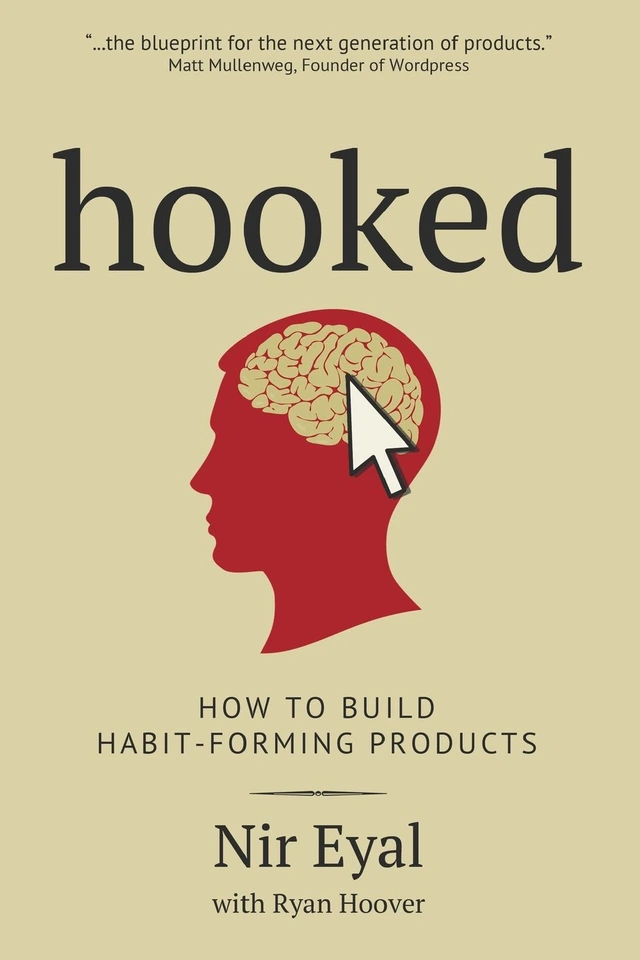
The formula was written down in Hooked, by Nir Eyal.
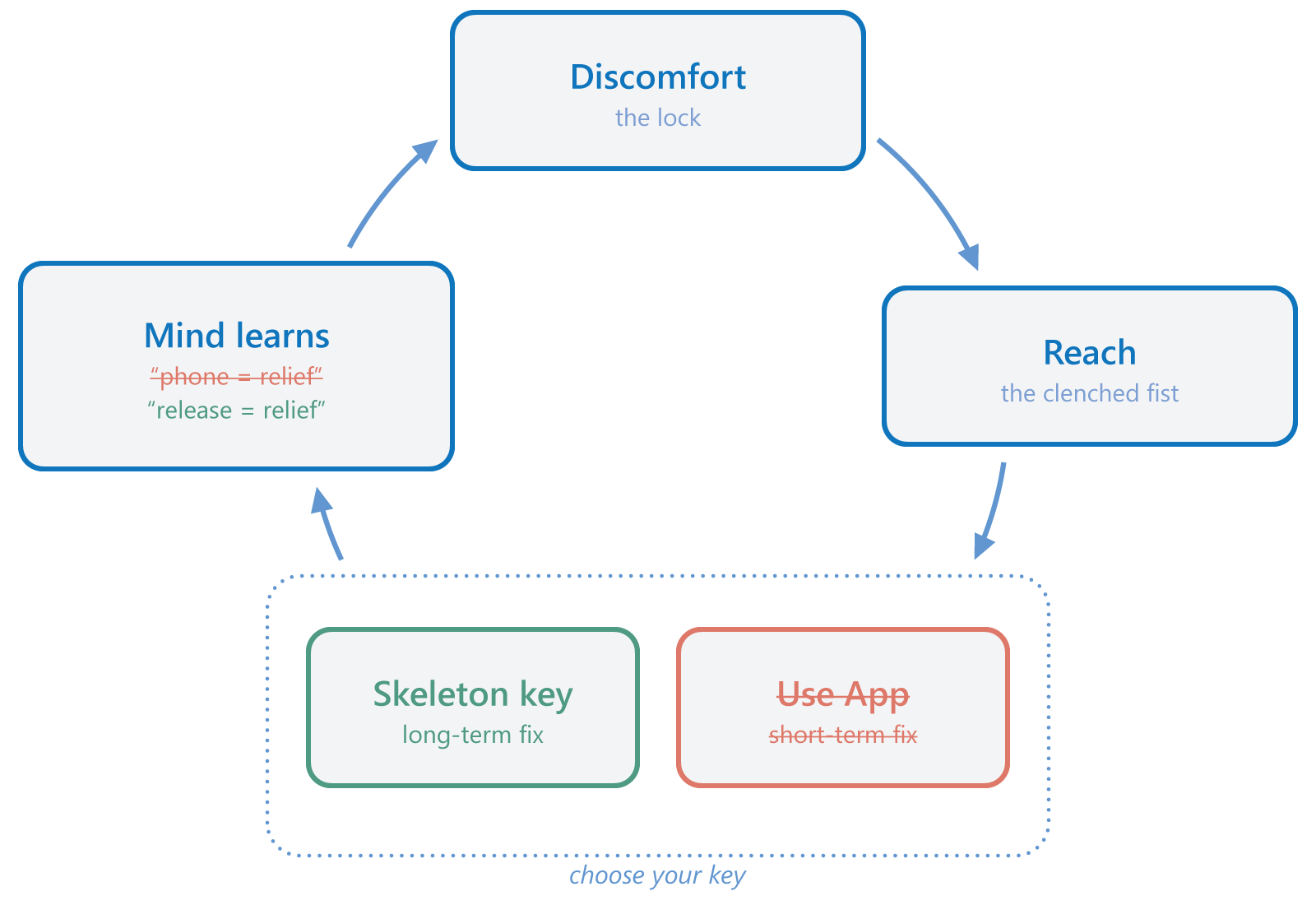
Think of it as a lock and key:
- The lock is your felt discomfort
- The keys are the solutions the app offers to relieve it
App creators attach the phone to a bad feeling, make relief effortless, and let the app learn what keeps you. Meanwhile, your mind learns that the phone is where relief lives.
The app never needs to know what’s behind the discomfort lock. It just tries keys until one fits. But that’s also its weakness: it never asks whether a key is a short or long-term fix.
It just keeps your attention hooked. And that has a price.
The cost, counted & felt
According to app-analytics firm Sensor Tower, the average smartphone user now spends 3.6 hours a day in mobile apps, or about 55 full days a year. In under eight years, that’s the 10,000 hours often linked with mastering a skill. Instead, those hours go into training your mind to reach for the phone.
But the cost goes deeper. We don’t live these hours as a number. We live them as texture.
[Attention] is the lifeblood of the quality of our experience in life.
Dr. Amishi Jha, Neuroscientist
Think back to that body check. Groggy, wired, flat, or expressive, energised, inspired. Same evening, same hours, completely different texture.
Because you get more of what you click on, the groggy evening can become your default. And you become what you repeatedly attend to.
So what if the deeply enjoyable, rewarding things could become your default instead?

Designing our skeleton key
So let’s reverse-engineer the Silicon Valley formula. We’ll make our own skeleton key: one key that opens many locks.
Next time you feel pulled away from something that matters…
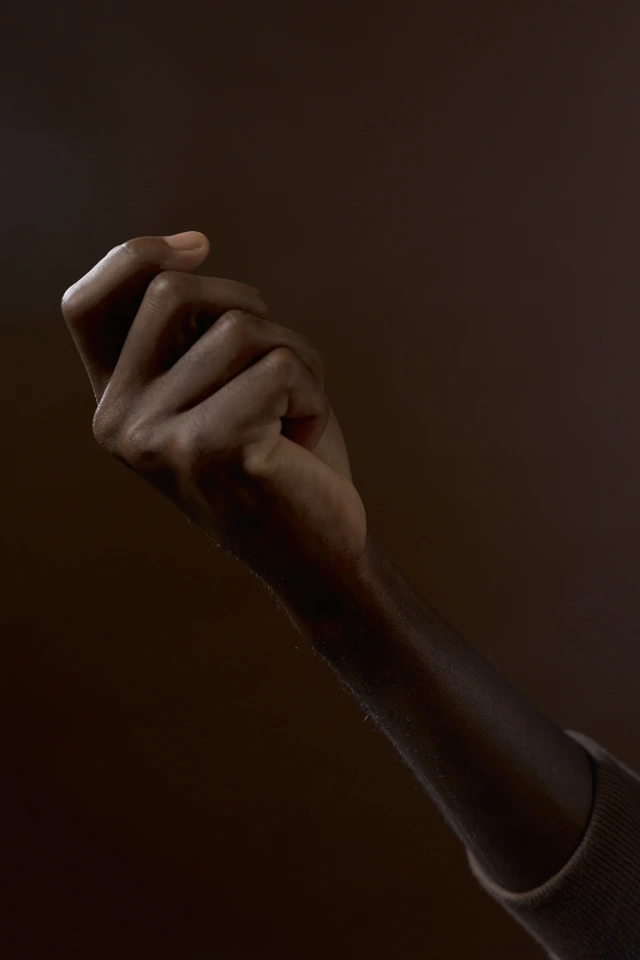
- Notice the reach and the texture: The tunnel vision, the dissatisfaction, the way your mind feels like a clenched fist.
- Name what you’re seeking relief from: Boredom? Uncertainty? Tiredness?
- Release the grip: Before deciding anything, let the fist in your mind dissolve. It helps to clench a real fist, then slowly let it go, and the tunnel vision with it.
- Decide: From here, go with what you’d rather do.
Same formula, different key. You notice the trigger and how it actually feels, and you reach for a key that’s even closer than your phone: your own attention.
And it works whether or not you reach for the phone.
If you don’t, try this: next time the urge hits, calmly watch it and see how long it lasts. Most people are surprised to find it peaks and passes on its own. Psychologists call this “urge surfing.”
If you do reach for the phone, keep noticing. Psychiatrist Judson Brewer has found that paying close attention to how a habit actually feels lowers its reward value. Your mind realises, “Hmm, this isn’t as good as I thought.”
So you won’t win every time, and you don’t need to.
Each rep of noticing or choosing differently is a new data point for retraining your mind. You find better ways to meet the need underneath. Your “mind algorithm” rebalances until picking up the guitar is a real option.
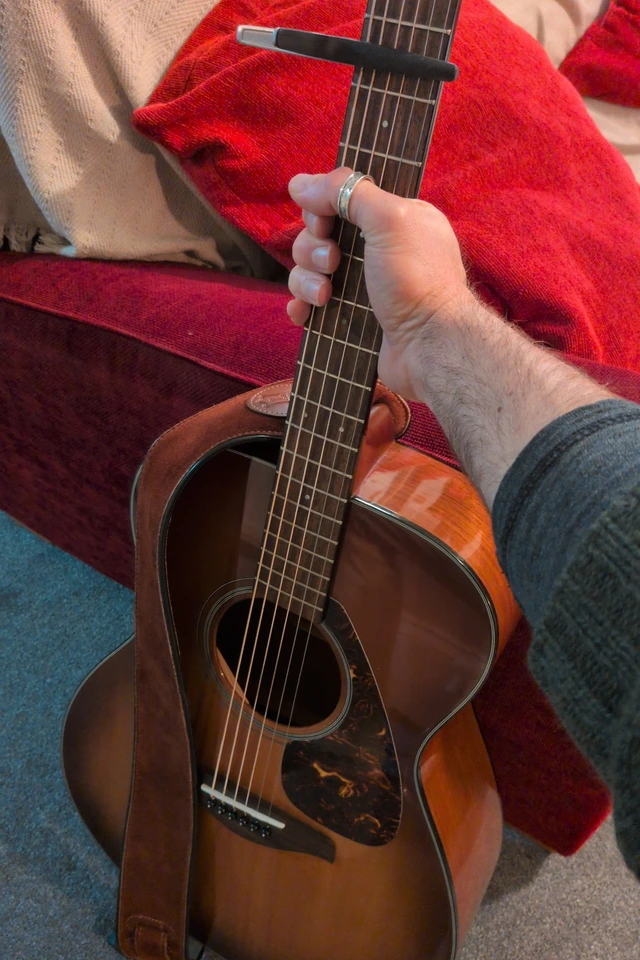
The skeleton key works from the inside, but you can also tilt the odds through your environment. If your mind gets more of what you click on, limit what’s available to click on in the first place. Your phone is always just a reach away, so add friction to the phone and ease to the guitar. My phone goes on Do Not Disturb and into another room around 9pm. My guitar now sits on a stand right next to my sofa, tuner and capo attached.
I noticed a difference within a couple of weeks. It compounds over months and years, and can reach into every area of your life — because attention touches everything. In my practice, I’ve also applied it to overeating, smoking and anxiety. I use it myself to catch intense thought and emotion loops and step out of them.
The trainee becomes the trainer
I hear my phone go off in the other room.
Guitar in hand, I stop strumming. I wonder what it is, notice the itch and reflexively clench and unclench my fist. My mind relaxes. Besides, I’m not getting up. I’m right here, enjoying the moment.
Not every evening goes this way, but most do now. They leave me feeling alive and full. I sleep better. And my range of guitar songs is growing.
Your mind is being trained either way. The only question is by whom.
I’d rather invest my attention in my own life than let an economy profit from it. Because attention compounds. And what you repeatedly attend to becomes who you are.
Try the skeleton key for a few evenings. In a few days I’ll send subscribers a free hypnosis track to help unclench the fist in your mind.
What’s your guitar, the thing you’d reach for if the phone didn’t get there first?
Sources
- The study of 35,000 people who left Facebook or Instagram for a few weeks: Allcott, H., Gentzkow, M. et al. (2025). The Effect of Deactivating Facebook and Instagram on Users’ Emotional State. NBER Working Paper 33697. nber.org
- Dr. Amishi Jha, both quotes: Jha, A. P. (2021, October 27). The Attention Economy [podcast episode]. Life, Meet Tech, WKAR, hosted by Prabu David. wkar.org
- The playbook: Eyal, N. (2014). Hooked: How to Build Habit-Forming Products. Portfolio/Penguin. penguin.co.uk
- 3.6 hours a day in mobile apps: Sensor Tower (2026). State of Mobile 2026. sensortower.com
- The 10,000 hours: Ericsson, K. A., Krampe, R. T. and Tesch-Römer, C. (1993). The role of deliberate practice in the acquisition of expert performance. Psychological Review, 100(3), 363 to 406. The round number is a popular simplification that Ericsson himself disputed. doi.org
- Urge surfing: Bowen, S. and Marlatt, G. A. (2009). Surfing the urge: Brief mindfulness-based intervention for college student smokers. Psychology of Addictive Behaviors, 23(4), 666 to 671. pubmed.ncbi.nlm.nih.gov
- Noticing lowers a habit’s reward value: Brewer, J. A. (2019). Mindfulness training for addictions: Has neuroscience revealed a brain hack by which awareness subverts the addictive process? Current Opinion in Psychology. Summary on his site: drjud.com