
Why willpower often fails



You’re a few days into your new habit. Yes, everything is going swimmingly. And then, in a moment of weakness, you slip! For the next week you find yourself neck deep in the sofa, indulging in the old behaviour that this new habit was meant to plug. What the hell just happened?
It turns out there’s more to willpower than meets the eye. As a culture, we’ve been running an outdated model of it for centuries, and new science is revealing both its shortcomings and what actually works. Used in the right place, willpower can finally get traction on the habits that keep winning: smoking, phone addiction, nail biting, procrastination, even anxious thought loops.
Key takeaways from this article
- You’re relying on willpower at the least impactful time
- Making habits stick is a skill, and anyone can learn it
- “High willpower individuals” are just people who have built better systems around their impulses
- Hypnotherapy can uncover the hidden function beneath your old habit
It’s not you, it’s your systems
Habit chains are quite simple: A trigger occurs → the impulse arises → you satisfy it.
This often happens without realising, because the behaviour is automatic.

We’re usually advised to “have more self-control” or “do something else”, but this advice doesn’t hold up in practice. Over time, we can internalise our repeated failure as evidence of something being wrong with us. We end up annoyed, and back in the exact behaviour we’re trying to escape.
And following “just try harder” advice keeps us there, because it’s the opposite of what works.
Relying on this type of willpower, what I call reactive willpower, is like remembering you left the oven on during takeoff on your flight to the Maldives. Conscious recognition and effort arrives after the window of opportunity has closed and the automatic process has begun.
To arrive earlier, we must move upstream from the repeated habit scenario and take a closer look at the inputs and mechanics that keep giving us the same output again and again: our behavioural systems.
Each system in our life is the best method we’ve arrived at for fulfilling a given want or need; A habit is your mind’s answer to something. There are often better answers.
And note: behavioural systems are made up of actions, but also thoughts. That’s why you’re arriving too late: your decision process is habitual in itself.

When we say someone has high self-control, what we’re really seeing is someone with stronger behavioural systems. They’ve designed their environment and internal decision making to put them up against fewer triggers, and they’ve built new ways of thinking about their problems. But we don’t see this system, we only see its output.
So remember the indulgent week on the sofa? Here’s what actually happened. You set the terms in your system: giving into the habit is not an option. So when the slip came, as slips do, the habit played out and you saw failure. You then resigned to the old habit, and the whole cycle was then taken as evidence for why you can’t change. But the plan was flawed from the start.
Habit change takes time and a slightly counter-intuitive approach. You’re not weak or set in your ways. It’s about learning to use your willpower where it counts: to adapt your systems, step outside the cycle of overwhelm and see beyond the stories of who you are that come with it.
Using the three types of willpower
The cultural idea that we have an inner agent with complete control over our actions is a remnant of Christian theology, now so deeply embedded in our culture that we can hardly imagine an alternative.
But if total free will exists, why does it keep losing to a bowl of crisps?
Well, you’re not a heathen, “an impulsive person” or broken. Science tells a more interesting story: You’re using the limited willpower you have in the wrong place.

Willpower is the effortful, conscious act of overriding a subconscious impulse. It’s one cognitive process among many. It’s slow, expensive and in high demand. It’s also constantly competing against processes that are fast, cheap and layered. To keep things optimised, the brain is constantly offloading repetitive behaviours into subconscious habits.
Deploying willpower against the hundreds of impulses we face every day — cravings for snacks, your phone, intense emotions, a smoke — gets the brain tired, fast.
So how can we use the limited resources in a way that gets us the results we seek? It helps to break willpower into three distinct types: reactive, responsive, and adaptive.
- Reactive: Trying to deny the impulse when the thought process and automatic behaviour have already begun.
- Responsive: Using trained awareness of early warning signals to deploy willpower at the earliest possible point in the habit chain.
- Adaptive: The deliberate act of observing our patterns and building better systems around the habit chain itself.
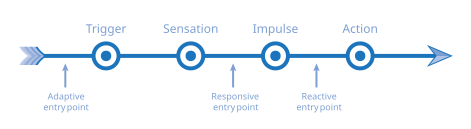
We’ve spoken about reactive willpower. The second type is more interesting.
Responsive willpower is a trained early warning system. It uses heightened awareness to catch the habit just as it’s starting, which is the earliest, lowest-friction place to intervene in the moment.
Every habit chain flows from trigger, to impulse, to action. And between the trigger and the impulse there’s almost always a faint bodily sensation. Most people never notice it. But it can be found and even used in reprogramming the habit. You learn to feel the thought process starting rather than realising the action is already happening. At that early fork, you can slip a new response in that, with practice, becomes the new automatic one.

Adaptive willpower is the type that lets you zoom out, reflect, and make improvements to your internal and external systems — like knowing when it’s time to get help. The opposite of behavioural autopilot is a system that observes itself, reflects and makes adjustments.
Which begs the question: what kind of adjustments? I imagine you’ve tried plenty: tips and tricks collected from books, Instagram, other people. But without a framework to use them in, you’re shooting in the dark. You’re navigating a complex old system with new, often conflicting fixes.
What’s usually missing isn’t another trick, but:
- A well-designed system
- A new idea of what progress looks like
- Knowing the job the old habit was actually doing
Using hypnotherapy to put willpower back in its rightful place

No amount of willpower is available to you when you’re dysregulated.
We can’t go beyond reactive willpower while we’re stuck in reactivity. So the first step is regulation, to ground the nervous system through breath and body exercises. Only then can the brain allocate resources to building responsive willpower.
This is where hypnosis comes in.
Hypnosis works with a lucid state of calm, focused attention. This makes it excellent for three things in this scenario:
- Building new ways for the mind to self-regulate
- Noticing the subtle early warning signals and programming new responses
- Training the repetitions that make the new response the automatic default
I pair hypnosis with mindfulness, to help catch the pattern live, and coaching, so we can question the beliefs about ourselves that have been reinforcing it.
Which brings us to the most common pitfall: heightened awareness of your own patterns can be frustrating.
Your brain has been shaped by millions of years of survival pressure to avoid threats of any kind — like the discomfort of doing inner work. Know one thing: Progress is not linear. Slips will come, with stress, exhaustion, bad weeks. The work is about sticking to the plan anyway.
This is how we retire the sofa cycle: progress stops meaning never slipping and starts meaning faster catching, faster recovery, and fewer slips.

Hypnosis has a further role here: Exploring if the habit is fulfilling some subtle but important function. Remember, a habit is an answer to something. Often we slip because the old behaviour was doing a job. The pressure of that unmet need builds until we return to the only answer we had.
Quit smoking cigarettes and you’ve also quit your break from work, your social membership, and your one reason to stand outside and do nothing. Stop scrolling on your phone and you’ve just lost your exit hatch from whatever unpleasant feeling came up a few seconds before.
Through hypnosis and its strengths, we can find out what the hidden function is, and build a new adaptive response to meet it without the old downsides.
It all takes practice. There’s no way around that. My role is to make the reps in the daily gym of the mind clear, coherent, and manageable.
With training, the willpower you do have finally starts landing where it counts.
And you’ll know what the hell just happened.